Source Mini Countertop Gelato Showcase Freezer for Ice Cream, Donut, Chocolate
Compare 30 Mini Countertop Gelato Showcase Freezer options from verified Chinese suppliers. These units support freezing and cold storage for ice cream, donuts, and chocolate with customizable features and mechanical or smart thermostat controls.
Key considerations
Products List


Dessert Shop Gelato Showcase with Different Colors
$1765.00 - $3260.00
MOQ: 1 Pieces
Guangdong Green & Health Intelligence Cold Chain Technology Co., Ltd.


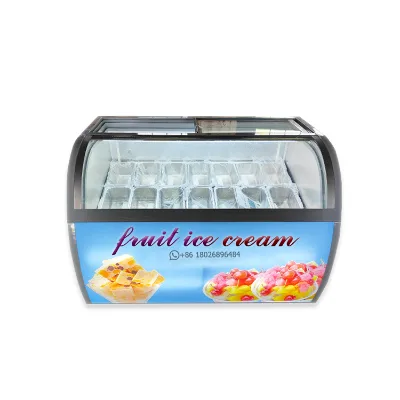


Top Open Glass Door Mini Refrigerator Showcase Frozen Food Display Fridge
$354.88 - $479.44
MOQ: 1 Pieces


Comprehensive Sourcing Guide
Strategic Sourcing Guide for Mini Countertop Gelato Showcase Freezers
The global demand for premium frozen desserts has driven a surge in specialized retail equipment, particularly the Mini Countertop Gelato Showcase Freezer. These units are engineered to maintain precise temperatures for high-fat, low-air-content products like gelato, sorbet, and soft-serve ice cream while offering an attractive display for customers. For procurement professionals, sourcing these units requires a nuanced understanding of technical specifications, regulatory compliance, and supply chain logistics. This guide synthesizes available market data to provide a disciplined framework for evaluating potential suppliers and selecting equipment that meets operational standards without relying on unverified marketing claims.
Technical Architecture and Operational Specifications
The core functionality of a Mini Countertop Gelato Showcase Freezer relies on a robust refrigeration cycle capable of sustaining sub-zero temperatures. Based on observed market data, the primary temperature requirement for these units is consistently below -18°C, a critical threshold for preserving the structural integrity and texture of gelato. The refrigeration system typically utilizes R290 refrigerant, a hydrocarbon known for its environmental friendliness and high energy efficiency compared to older fluorinated gases. This aligns with modern sustainability goals while ensuring effective heat transfer.
Power consumption and voltage compatibility are paramount for global deployment. The observed voltage range for these units spans 110240V at 5060Hz, offering flexibility for international markets. The power source is exclusively electric, requiring a stable grid connection. In terms of temperature management, the industry observes two distinct control methodologies: mechanical thermostats and smart thermostats. Mechanical systems provide a direct, analog approach to temperature regulation, often preferred for their simplicity and durability in high-traffic environments. Conversely, smart thermostats offer digital precision and potentially remote monitoring capabilities, though buyers must verify the specific implementation in any quoted unit.
The physical configuration of the unit is equally critical. Most observed models feature a single-door design, which can be either a folding door or a swing door. Folding doors are often selected for their space-saving profile in tight countertop environments, while swing doors may offer easier access for restocking. The dimensions of the units vary significantly based on capacity and model. For instance, specific models have been observed with dimensions around 6815911084mm, while others are more compact at 463472361mm. The standard capacity for these units generally falls within the 101-200L range, though some specialized models may differ. The defrost mechanism is predominantly manual, a factor that influences operational labor requirements and maintenance schedules. Buyers should verify if a specific model includes automatic defrost features, as this is not the universal standard in the observed dataset.
Compliance, Certification, and Regulatory Standards
Navigating the regulatory landscape is a non-negotiable aspect of B2B procurement. The safety and environmental compliance of the equipment must be verified against the standards of the destination market. The most frequently observed certification in the current market data is the CE mark, indicating conformity with health, safety, and environmental protection standards for products sold within the European Economic Area. Some suppliers also list ISOCE, which may imply a combination of ISO standards and CE compliance, though buyers should request specific documentation to clarify the scope of this certification.
Beyond the CE mark, a comprehensive evaluation should look for a broader suite of certifications, including RoHS (Restriction of Hazardous Substances), CB (International Electrotechnical Commission System for Certification to Standards for Electrotechnical Equipment), EMC (Electromagnetic Compatibility), GS (Geprüfte Sicherheit), and ETL (Intertek). The presence of these certifications suggests that the unit has undergone rigorous testing for electrical safety, electromagnetic interference, and material safety. It is essential for buyers to request valid certificates for each specific model, as certifications are often model-specific and not blanket approvals for a supplier's entire catalog.
The product standards also define the physical and performance baselines. Observed data references specific standards such as "98L" for capacity and dimensional standards like "126010881460mm" for larger units. When evaluating a supplier, buyers must ensure that the "prod_standard" listed matches the physical reality of the unit. For example, a unit claiming a 98L capacity must physically accommodate that volume within the stated dimensions. Additionally, the "Automatic Grade" is listed as "Automatic" in some contexts, which may refer to the manufacturing process or the control system's automation level. Buyers should clarify this attribute to ensure it aligns with the desired level of operational automation.
Cost Drivers and Pricing Dynamics
The pricing of mini countertop gelato showcase freezers is influenced by a complex interplay of factors, including capacity, material quality, control technology, and certification breadth. The observed price range in the market spans from $110 to $6,899 USD. This wide disparity indicates that the market is segmented into entry-level, basic models and high-end, feature-rich commercial units. The lower end of the spectrum likely corresponds to smaller, mechanically controlled units with standard packaging, while the higher end may include units with smart thermostats, advanced insulation, or specialized branding options.
Minimum Order Quantity (MOQ) is another significant cost driver. The observed MOQ range is between 1 and 63 units. A low MOQ of 1 allows for single-unit procurement, which is ideal for testing or small-scale operations, but may come with a higher per-unit cost. Higher MOQs, such as 63 units, typically unlock volume discounts but require a larger capital outlay and storage capacity. Buyers must balance their immediate needs against the potential for economies of scale.
Packaging standards also impact the final landed cost. The market data indicates a variety of packaging methods, ranging from "Strong Export Carton" to "Wooden" cases and "Wooden Case" configurations. Wooden packaging is generally more robust and suitable for heavy units or long-distance shipping but adds to the weight and cost. The weight of the units, observed at approximately 50kg for some models and up to 275kg for larger variants, directly influences shipping logistics and freight charges. Buyers should factor in the cost of specialized handling for heavy wooden-cased units when calculating the total cost of ownership.
Typical Applications and Functional Versatility
While the core keyword focuses on gelato, the functional versatility of these units extends to a broader range of frozen and chilled products. The primary application is the display and storage of ice cream, but the observed data also highlights suitability for donuts, chocolate, and general cold storage. The process type is defined as "Frozen and Chilled," indicating that the units can maintain a range of temperatures suitable for different product types. This versatility makes them valuable assets for ice cream parlors, cafes, bakeries, and convenience stores.
The "Cold Control" mechanism, observed as "Mechanical" in many instances, ensures that the temperature remains stable without complex electronic intervention. This is particularly beneficial for environments where reliability is prioritized over data logging. The "Top Ad Light" is an optional feature, allowing retailers to customize the visual appeal of the display. This customization is crucial for branding, as the "Color" of the unit is often customizable to match the retailer's aesthetic. The ability to customize the color and lighting allows businesses to create a cohesive brand experience that enhances product visibility and customer engagement.
Supplier Evaluation and Origin Verification
Identifying a reliable supplier requires a thorough vetting process that goes beyond the product listing. The origin of the products is a critical factor, with the majority of observed units originating from China, specifically from regions like Shandong, Jiangsu, and Nanjing. These regions are known for their manufacturing clusters in the refrigeration industry. However, the specific location within China can influence the supply chain's resilience and the supplier's expertise. Buyers should verify the specific factory location to ensure it aligns with their quality expectations and logistical preferences.
The "Customization" attribute is widely available, indicating that suppliers are willing to tailor units to specific requirements. This can include custom dimensions, colors, or branding. However, buyers must be cautious when requesting customizations, as they can extend lead times and increase costs. The "prod_packing" attribute, ranging from export cartons to wooden cases, should be verified to ensure it meets the shipping requirements of the destination. Additionally, the "Automatic Grade" being listed as "Automatic" suggests a level of manufacturing precision, but buyers should confirm if this refers to the assembly line or the product's operational features.
Quality Control and Long-Term Procurement Considerations
Ensuring the long-term reliability of mini countertop gelato showcase freezers requires a proactive approach to quality control. Buyers should implement a rigorous inspection protocol that includes verifying the "Temperature" stability, the integrity of the "Door Type" seals, and the functionality of the "Defrost Type" mechanism. The "Weight" of the unit, observed at 50kg for some models, is a proxy for the density of the insulation and the quality of the compressor. Heavier units often indicate better insulation and more robust construction, which translates to better energy efficiency and longevity.
Long-term procurement considerations also involve the availability of spare parts and technical support. The "Refrigerant" type, R290, is becoming the industry standard, but buyers must ensure that the supplier has a supply chain for this specific refrigerant and that the service technicians are certified to handle it. The "Voltage" compatibility should be confirmed against the local grid to prevent damage to the unit. Furthermore, the "Temperature Control" system, whether mechanical or smart, should be evaluated for its ease of maintenance and the availability of replacement parts.
In conclusion, sourcing mini countertop gelato showcase freezers requires a balanced approach that considers technical specifications, regulatory compliance, cost dynamics, and supplier reliability. By adhering to the observed data and maintaining a disciplined verification process, buyers can secure equipment that meets their operational needs while minimizing risk. The wide range of options available, from basic mechanical units to advanced smart models, offers flexibility for various business models, provided that the selection is grounded in verified facts and rigorous due diligence.
| Feature Category | Observed Attributes | Verification Requirement |
|---|---|---|
| Temperature | <-18°C | Verify actual operating range under load. |
| Refrigerant | R290 | Confirm local regulatory acceptance of hydrocarbons. |
| Voltage | 110 | Match with local grid frequency and voltage. |
| Door Type | Single, Folding, Swing | Check seal integrity and opening mechanism. |
| Control | Mechanical, Smart | Test thermostat accuracy and response time. |
| Certification | CE, ISOCE, RoHS, ETL | Request valid certificates for specific model. |
| Origin | China (Shandong, Jiangsu, Nanjing) | Verify factory audit and production capacity. |
| Packaging | Carton, Wooden Case | Assess protection level for shipping distance. |
| Capacity | 101-200L (Typical) | Confirm internal volume vs. external dimensions. |
| Customization | Available (Color, Light) | Clarify lead time and cost implications. |
FAQs
What temperature does a Mini Countertop Gelato Showcase Freezer maintain?
These units maintain temperatures below -18 degrees Celsius to preserve gelato texture. This sub-zero threshold is critical for structural integrity and is consistently observed across standard models in the market.
Which refrigerant is typically used in these freezers?
R290 refrigerant is the standard choice for these units due to its environmental friendliness and energy efficiency. This hydrocarbon gas ensures effective heat transfer while aligning with modern sustainability goals for commercial equipment.
Can the color of the freezer be customized for branding?
Yes, the color of the unit is customizable to match specific retailer aesthetics. This flexibility allows businesses to create a cohesive brand experience while maintaining the required operational performance for frozen dessert display.
What certifications are commonly found on these showcase freezers?
Common certifications include CE, RoHS, ISO, CB, EMC, GS, and ETL for safety and compliance. Buyers should verify specific certificates for each model as certifications are often model-specific rather than blanket approvals.
How is the temperature controlled in these units?
Temperature control is managed via either mechanical thermostats or smart thermostats depending on the model. Mechanical systems offer analog simplicity while smart thermostats provide digital precision and potential remote monitoring capabilities.
What is the typical voltage range for these electric freezers?
The voltage range spans from 110 to 240 volts at 50 to 60 hertz for global compatibility. This flexibility ensures the units can operate on stable grid connections in various international markets without conversion issues.
Which door types are available for these countertop freezers?
Available door types include folding doors and swing doors, often configured as single-door designs. Folding doors save space in tight environments while swing doors may offer easier access for restocking operations.
What is the minimum order quantity for these freezers?
The minimum order quantity ranges from 1 to 63 units depending on the supplier and model. A low MOQ allows for single-unit testing while higher quantities typically unlock volume discounts for larger procurement needs.